Haft Khān-e Rostam Suite
Rostam was a legendary Iranian hero whose story is recounted in the famous Book of Kings by the Persian poet Ferdowsī (932-1020). As guardian of the Throne and Crown, Rostam is a fearless warrior who derives his incredible physical strength from his unwavering faith in God. As he sets out to rescue his king, whose excessive pride has led him to conquer the lands of giant demons, Rostam must undergo seven (haft) great ordeals (khān) in his arduous journey. Used metaphorically, the expression “Haft Khān-e Rostam” (the seven ordeals of Rostam) refers to the successive ordeals one must undergo in order to reach a particular goal.
The Haft Khān-e Rostam suite is inspired by this story and implies the inner progression of someone confronted with a succession of obstacles separating him from his divine King, the Beloved. Ostad Elahi frequently incorporates narrative references in his music as a foundation to help the audience grasp the spiritual levels and stages of the metaphysical world, inviting them to explore these realms. The "Seven Trials" (Haft Khān) may also be a reference to the Seven Valleys of Love by Attār, the 12th-century Persian poet and mystic: the Valley of the Quest, the Valley of Love, the Valley of Knowledge, the Valley of Detachment, the Valley of Unity, the Valley of Wonderment, and the Valley of Poverty and Annihilation in God (Fanā fil-Lāh). In the course of the suite, each of these seven sequences (called Khān-e 1, Khān-e 2, etc.) appears, sometimes very briefly, through a rigorous and “classical” musical structure (first theme, second theme, development, return to initial theme).
The tanbur is tuned in a rather low pitch, in fifths instead of the usual fourths. The overall atmosphere is fairly solemn before it gradually livens up in higher registers through the use of the rolling shor, a technique typical of Ostad Elahi’s art.1 Chromaticism, the alteration of notes played on the low string, and the succession of fifths on syncopated or regular rhythms depict the inner struggle that takes place, eventually resolving into the ecstasy of the final encounter.
a. Khān-e 1
Extreme sobriety permeates the entire piece, which remains within a single semitone; an intensified effect results when a whole tone appears.
b. Khān-e 2
A higher note provides a hint of freshness and clarity; a counterpoint appears on the low string. A new theme then arises in a short and luminous mode close to the major mode.
c. Khān-e 3
Ostad lingers on one note. Then, a succession of fifths and the chromaticism of the melody, along with its inexorable rhythm, urge the listener to carry on.
d. Khān-e 4
The invariable rhythm expresses a kind of obstinacy.
e. Khān-e 5
An unprecedented note located beyond the fifth transforms the relations between the elements and introduces an unexpected mode.
f. Khān-e 6
A higher register and the emergence of a bright pattern enhance the nobility of the whole sequence.
g. Khān-e 7
Like a leitmotif, the chromatic fifths are repeated; the playing reaches the heights of virtuosity.
1 Ostad created several kinds of shors. The most frequent consists of successively striking the strings with the fingertips of the right hand (beginning with the thumb and proceeding to the little finger.) The repetition of this gesture at a constant speed produces a continuous rolling sound.
Haft Khān-e Rostam Suite
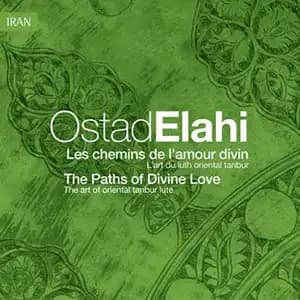
The Paths of Divine Love