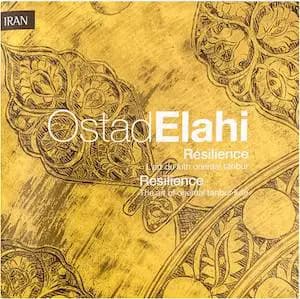
Shīn-e Tarz in the Nakīsā and Bārbad Suite
This piece was recorded in the 1970s at Ostad Elahi’s home in Tehran. It highlights the virtuosity, power, and speed of his playing, both with his right and left hands. The main theme evokes the story of Nakīsā and Bārbad, two characters of ancient Persia who were famous musicians at the court of King Sassanid Khosrow Parvīz in the early seventh century. According to Kurdish gnosis, they are bound by a deep and unwavering spiritual love, comparable to that of Joseph and Jacob, or of Jesus Christ and John the Baptist. Having undergone the trial of separation, they were finally reunited after overcoming many obstacles. Ostad liked to honor their memory and often mentioned their names when he played their melody in the midst of an improvisation.
As was the case for classical music of Persian masters,1 Ostad’s music is based on the different states and needs of the soul. Thus, this heartbreaking suite vividly depicts the states experienced by true spiritual lovers, including profound nostalgia, the pain of separation from the Beloved, and the soul’s resilience in overcoming this pain. This improvisation is not based on and cannot be linked to any ancient, pre-Islamic foundation. It contains passages of Ostad’s repertoire, but they are played differently and in a new sequence. At first, the piece is meditative, but it then invites the listener into a dense and intense soundscape in which the most surprising resonances echo one another.
Although the tempo increases, driven by a brilliant shor,2 the piece remains quite nostalgic at first. Successive waves are unleashed as so many cries for help. The repetitions are increasingly virtuosic, calmed by pauses from which dissonances still emerge, like a sorrow that has not yet been alleviated. Amid these cascades of notes, unexpected chords arise that gradually bring about a change in the atmosphere. Toward the end, Ostad plays a joyous air, a kind of catharsis, of plenitude, before returning briefly to the main theme pursuant to a pattern that is frequently found in his improvisations.
1 According to Ostad Elahi, “It is for the soul that the Iranian masters created their music, looking each time for the air that was the most suitable, the melody that would make the soul joyful and buoyant at that moment. This even includes music tinged with nostalgia, for weeping calms the soul and procures joy.” Āsār ol-Haqq, vol. 2 (Tehran: Jeyhūn, 1991), 359-360.2 A type of roll played with the right hand.
Shīn-e Tarz in the Nakīsā and Bārbad Suite
Resilience