Samā
Samā,1 whose various meanings include “audition,” refers both to the mystical concert and the cosmic dance induced by this audition, a meaning that gained prominence in the 13th century under the influence of Mowlānā Rūmī. According to this great Persian poet and mystic, “The Samā constitutes but a small part of the eternal dance the soul is destined to join one day. Every being partakes in this cosmic dance. . . .”2
Samā expresses a melody that comes “from the firmament” (samāvāt: heavens) to resonate in the soul and sweep the listener away in a dance that Ostad has described as celestial. This improvisation was recorded in the 50s by Ostad’s eldest daughter while he played alone in his room. Rendered on a five-stringed tanbur (panj sīmī),3 it provides a good example of Ostad’s unique technique, notably his singular style of combining playing techniques from the tanbur with those of the setār (see also track 4).
The suite opens with a series of themes, often composed of simple notes that convey a heightened sensitivity. Recurring tremolos impart an intimate character to the melody, which conveys the profound nostalgia of a fettered soul unable to rejoin its Creator. The melody gradually strengthens, supported by an accompaniment of chords that slowly replace the tremolos. The atmosphere shifts, with alternating dissonances and free-flowing solos. Following a rubato cycle of rhythm variations (slowing down then returning to tempo), the sound becomes fuller and the movement of the cosmic dance sweeps the soul away in an increasingly powerful flux, accompanied by the following chant:4
Āmān sad āmān wa āmāna kū
Ya das[t]-e mena / Ali wa dāmān-e toYour help I implore a hundred times over, but where is Your help?
Here is my hand that grasps the hem of thy robe
1 See Ostad Elahi, Celestial Dances, compact disc (Paris: Le Chant du Monde, 2005).2 Jean During, Musique et extase (Paris: Albin Michel, 1988), 200.3 Panj sīmī: A special five-stringed tanbur (two double-strings for trebles and mediums, and a single string for the bass) invented by Ostad Elahi. See Celestial Harmonies, compact disc (Paris: Le Chant du Monde, 1994/2004).4 It is difficult to convey the full meaning of this song, expressed in Kurdish in a simple but powerful way. As Jean During states: “The language of these songs is admirably adapted to the expression of mystical love, with its poetic turns of phrase that are audacious, concise, and striking while exhibiting great freedom.” The Spirit of Sounds: The Unique Art of Ostad Elahi (Cranbury, NJ: Cornwall Books, 2003), 75-6.
Samā
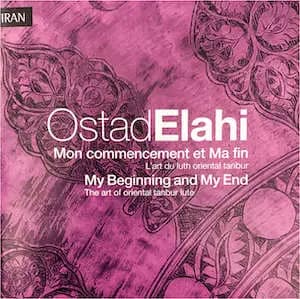
My Beginning and My End