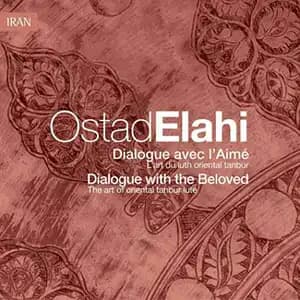
Shāh Hoseynī Suite (Part One)
a. Shāh Hoseynī (Tune of Shāh Hoseyn)
The origin of this melody is unknown. The first notes sound a call, with a counterpoint in the low register. Sometimes Ostad lingers on one or two notes, or keeps the beat in a more persistent way, as if wishing to give weight to a request. Then a very strange harmony arises and the link is established: one wanders about in marvelous musical landscapes in a higher register. After returning to the initial theme, a more joyful polyphonic passage is rendered in a lower pitch.
b. Bālā Dastān (Lower register of the tanbur’s neck)
The name of this traditional tune suggests that it is played in a low pitch, but Ostad Elahi develops it by utilizing the full register of the tanbur.
c. Zīr-e Dastān (Higher register of the tanbur’s neck)
This piece suggests a free play of questions and answers between the high (zīr) register and the low (bālā) register, corresponding to the last seven frets and the first seven frets, respectively. The mode is joyful, resembling the major mode; certain passages give the impression that two tanburs are playing at the same time.
d. Do Bālā
Bālā refers to a particular segment of the scale. Some believe that this is also the melody of a dance where one stretches out the arms like two (do) wings (bāl).
e. Karīm Khānī (Tune of Karīm Khān)
The enthusiasm is sustained until a change in the rhythm generates a gradual appeasement.
f. Chūpānī (Tune of the Shepherd)
The atmosphere is more serene now, the melody recited on the instrument. There are only a few reminders of the previous agitation, like an inner murmur.
g. Bārīya Bārīya (Royal Court)
The title of this piece alludes to the Court of the Lord, the Divine Threshold. This melody was a song before being conveyed in its instrumental form. The title also refers to a chapter of the Kurdish sacred scriptures (15th century, Ahl-e Haqq) in which one of Soltān Sahāk's seven companions is said to have discovered his own divine essence and recalled all of his successive manifestations in the course of sacred history. The chromatic theme is at once strange and fascinating. The intervals formed with the lower voice, as well as the rhythm, produce an air of majesty.
Shāh Hoseynī Suite (Part One)
Dialogue With The Beloved