
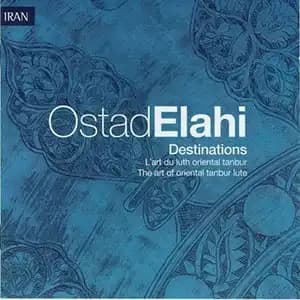
Suite Ābedīnī, with a Yādegārī Introduction
This suite, the pure expression of a profound quest wherein material preoccupations have no role, is the supplication of one who aspires solely to meeting and reuniting with the Beloved. The piece has moments of pure imploration calling upon the intercession of Bābā Yādegār, Soltān’s companion and the manifestation of one of the seven archangels. His indifference to base worldly matters makes him a symbol of the esoteric aspects of the relationship with God.
The story of Ābedīn is one of the accounts passed on orally in the Ahl-e Haqq tradition; it is included in The Book of the Kings of Truth, a mystical epic written around 1912 by Ostad Elahi’s father, Hādj Nematollāh. Ostad himself has written a detailed commentary on this work entitled Hāshīye bar Haqq ol-Haqāyeq. The story of Ābedīn is as follows: A devout man at the time of Soltān had four sons, three of whom embraced the mystical faith of their father and believed in Soltān as the earthly manifestation of the divine essence. But the fourth son, Ābedīn, denounced this mystical approach as heresy, placing his enthusiasm and faith in Islamic theology and jurisprudence instead. According to Ābedīn, the salvation of the soul lay in the literal study of the holy texts and the rigorous application of exoteric rules. He felt such animosity toward Soltān and his followers that he even strewed thorns along the path leading to Soltān’s abode to lacerate the feet of pilgrims going to see him.
When Ābedīn’s father sought Soltān’s counsel, the latter replied, “Leave your son alone. Though he doesn’t possess the same faith as your other children, his soul is even purer than theirs. The day he reaches illumination, he will become as my own son.”
A few days later, Ābedīn, engrossed in his theological studies, felt a wave of mystical exaltation rising within him, something he had never experienced till that day. Suddenly lifted outside of himself, he found himself projected into another dimension where the secrets of creation were revealed to him and his previous lives were disclosed to him.
When he came to, he was no longer the same man. Whatever he gazed upon, even the tiniest thing, he could feel the presence of Soltān’s essence. As though inebriated with this essence, he threw all his books and lessons into the water; they were no longer of any use to him. While all this was happening, a few beautiful young women were sitting at the water’s edge. Ābedīn’s teacher (a holy man) had witnessed the whole event, but thought Ābedīn’s wild gestures were a reaction to seeing the beautiful young women and designed merely to attract their attention; he rebuked him, invoking punishment and divine wrath. But Ābedīn’s feelings were elsewhere. His newly enlightened heart longed for different shores. In a state of exaltation, oscillating between passion and remorse, he rushed off toward the abode of his Beloved and henceforth became one of Soltān’s close companions.
In this suite, Ostad Elahi sings some lines from the long poem recounting the story of Ābedīn. The instrument is tuned in fifths (Tarz). From the very start, we are plunged into the heart of a deep meditation. In spite of the reduced range of the melody in the early part of the work, it is extremely intense. The notes of the motif never follow one another in the same manner. Through ornamentation, rhythm, and phrasing and their different combinations, the whole piece is constantly renewed and recreated. The play of chromatic fifths between the lower and higher registers gives dramatic fullness to the piece, expressing the noble quality of the quest. A counter-melody played in chromatic notes on the low string imbues the work with a mood of deep longing and nostalgia, a sign of the heartrending suffered due to separation from the Beloved.
A few lyrical passages at the higher end of the scale reinforce these feelings, which are then aroused again by their seemingly obvious musical treatment in the form of the most delicate intervals (a succession of fifths, augmented fourths, a major seventh). Finally, the voice joins the instrument in its expression of this quest.
Suite Ābedīnī, with a Yādegārī Introduction
Destinations