Sheykh Amīrī Suite
Sheykh Amīrī is a generic term designating a type of melody and a specific way of tuning the tanbur in fourths, known as kūk-e Sheykh Amīrī. The basic melody dates back to the time of Sheykh Amīr, an 18th century Kurdish mystic who was a simple, illiterate shepherd. As a result of a sudden illumination and spiritual awakening, he was inspired with numerous symbolic poems replete with mystical and philosophical teachings.
Ever since Sheykh Amīr, this melody has become the archetypal musical appeal to the Beloved in the context of this mystical tradition. It is often sung at the beginning of a religious meeting to prepare the adherents to detach themselves from their worldly preoccupations and to meditate on their true origins and the homeland from which they’ve been separated. It is usually followed by other more lively pieces with a stronger rhythm.
Ostad Elahi’s repertoire contains seventeen variations of the melody, some of which go under the title of Sheykh Amīrī followed by a person’s name, for each one is attributed to its composer; others are designed to pay tribute to a spiritual personality (e.g., Sheykh Amīrī-e Hādj Nemat, Sheykh Amīrī-e Shāh Hayāsī); still others go under the title of Sheykh Amīrī followed by the name of the region where they’re traditionally played (e.g., Sheykh Amīrī-e Gūrān (from the Gūrān area), Sheykh Amīrī-e atrāf-e Sahne (from the Sahne area, with its three variants)). The least complex of these different versions is that of Sheykh Amīr himself, and the most elaborate that of Ostad Elahi.
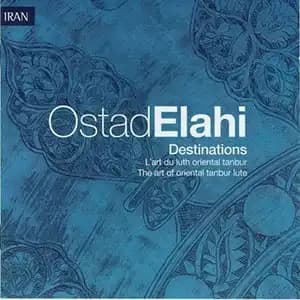
The suite featured on the present CD comprises all the versions of Sheykh Amīrī, one of the most captivating and meditativepiecesin the Ostad Elahi’s whole Ostad Elahi’s repertoire. Each of the seventeen melodies expresses a close personal relationship with the Beloved, embellished, ornamented, and integrated into a varied yet homogenous whole. The introduction, soft but dense, immediately demonstrates the exceptional talent and finesse of Ostad.
The Sheykh Amīrī piece is inherently simple but difficult to execute. In general, the song provides the matrix that enables the basic structure of the melody to be preserved while offering infinite possibilities for variation. In the case of Sheykh Amīrī, however, the two do not coincide and matching song to the tanbur is indeed a perilous exercise. To add to this difficulty, Ostad Elahi’s personal style consists of rich and subtle ornamentation, using shors1, vibrations, vibratos, and the plucking of strings, all of which require a technique that demands extreme dexterity.
It should not be forgotten that the tanbur uses a regular chromatic scale, and dividing the octave into twelve semitones of equal value means any melody can be played on any basic note, thereby offering an infinite number of combinations. The numerous passages occur in what seems like a random order, though it is in fact predetermined, always producing a feeling of meditation even in passages where the rhythm is tenser and less stable, especially toward the end of the piece with the passage of a perfect fifth to an augmented fifth. But calm returns with Ostad’s version. In spite of its density, this part gives a profound impression of deep peace; from an uninterrupted flow of music and a cascade of notes somehow emerges a feeling of serenity and gentle melancholy tinged with sweetness, one of the paradoxes of Ostad’s style.
1 The shor is a roll, a tremolo typical of the Kurdish tanbur style. Ostad Elahi perfected a technique in which each finger was used autonomously, quite distinct from the others. The most frequently occurring shor consists of striking the string with the fleshy part of the fingertips of the right hand, one finger after the other, at a constant speed so as to produce a continuo.
Sheykh Amīrī Suite
Destinations