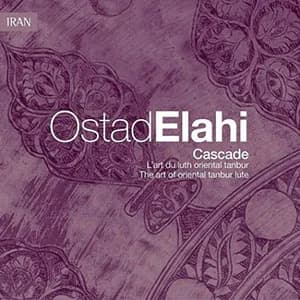
Cascade
Ostad was well-versed in the techniques and repertories of instruments in the Persian classical tradition. The influence of the classical tradition became perceptible in his playing of the tanbur, which in turn inspired his interpretation of pieces in the classical Persian repertory. Seeking to achieve a synthesis of the Persian and Kurdish lutes (the setār and tanbur, respectively), he designed and built an original instrument—a tanbur with five strings—that enabled him to integrate the characteristic techniques of the setār and the tanbur. It was on this five-string tanbur, which he alone could play, that Ostad expresses himself here in a piece entitled the Qatār suite.
The term Qatār covers a wide range of meanings. Depending on the context, it can mean advancement, train, caravan, convoy, chain, link, or liaison. In addition to being the name of a musical mode in the repertory of the classical Iranian tradition, Qatār also designates an ancient modal suite that provides the origins of the modern mode, whose resonances can be heard echoing in certain peculiarities in Ostad’s playing. The Qatār mode is a profound, intimate mode that is not very rhythmic, evoking a sense of prayer and contemplation. What is remarkable here is the way in which Ostad fleshes out his interpretation of some twenty pieces that he describes as being in the Qatār mode, playing them in the aura, tonality, and tuning characteristic of Qatār while connecting one piece to the next with the fluidity of a cascade. Approximately forty minutes in length, the Qatār suite rendered here is considered among the most complete recordings that remain of Ostad’s music.
Cascade
Cascade