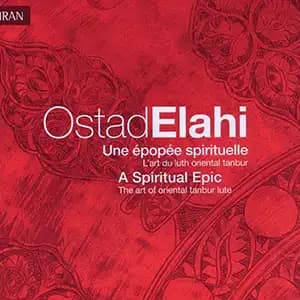
Tarz-e-Yārī Suite
Tarz is a generic term that literally means “rule, manner, or way.” In Ostad Elahi’s repertoire, it also refers to a sequence of tunes belonging to the category of ancient and mystical melodies, only a few of which are performed here. They all rest on a C C♯ D chromatic modal nucleus, which makes them technically and aesthetically unique (these notes are transcribed one and a half tone higher than they are actually played).
The atmosphere surrounding the Tarz mode is solemn, gradually livening as it reaches the higher register. It suggests an archaic or primitive melodic world prior to the invention of scales, an introverted emotional stage where singing was still confined to the narrow register of speech. This expressive archaism is probably the manifestation of a cultural trait. The Tarz mode only exists in Kurdestān and Pāmīr, two regions that have been particularly well-preserved from external influences and are still characterized by many of the cultural patterns of ancient and pre-Islamic Iran. Indeed, Tarz stands out as a totally unusual musical form in the Middle-Eastern modal tradition.
Immediately conjuring up the idea of something very ancient and fundamental, the Tarz mode’s chromatic notes seem to echo a sort of prehistoric music, its melody resembling speech more than singing. Played on the lowest chords and notes, its rhythm is neither measured nor totally free. While these features as a whole allow for a strong narrative potential, the true domain of Tarz is that of interiority, intimacy, and secrecy. The various phases of the improvisation draw on fundamental mystical themes, while the hidden anguish of separation lurks in the background.
(A) Before engaging in his narrative, the traditional storyteller would begin with: “Once upon a time,” to which he would sometimes add, “There was no one but God” (Yekī būd, yekī nabūd, gheyr az Khodā, hītch kas nabūd). It is with the latter part of this phrase that the tanbur appears to open the narrative, the memory of a time before creation when, according to the mystical gnosis to which this music constantly refers, the universe was empty except for the seven archangels absorbed in the ecstasy of contemplating God. According to the traditional myth of the Creation, the seven archangels had to relinquish their celestial universe and descend to earth, for the principle of the process of spiritual perfection required that they experience human existence to fulfill their mission. This is how a vast spiritual epic began, traces of which can be found in the books, sacred scriptures, and oral traditions of the various revealed religions. The recurrent principle is that of separation from divine proximity, followed by a long quest for the Beloved that eventually culminates in the ecstasy of reunion.
The first theme is called Tarz-e-Yārī (Tarz of the Companions of the Beloved). Composed of seven parts, an allusion to the archangels, it is a nostalgic evocation of pre-eternity accompanied by the sighs of separation. The first of these parts was transmitted to Ostad by his father, Hādj Nemat.
The ancient melodies from which Ostad would draw inspiration for his compositions and improvisations were generally mere patterns or schemes for the cantillation of sacred texts. Although accompanying these texts with the tanbur provided them with an artistic touch, the playing of this instrument had never been developed to the point where it could be considered as an art in its own right.
In classical Indian music, the sign of high mastery is not so much the virtuosity that one might display in the performance of rhythmic pieces with fast tempos as it is the creativity and self-restrained power required by the slowest and most expansive phases of the alap. If Ostad’s art is particularly impressive during the sequences of high virtuosity, it stands out even more forcefully with the minimal pattern of the three chromatic notes of Tarz, to which he manages to confer an unexpected depth. In fact, no tanbur player has ever been able to develop the expressive potential of these few notes in such a powerful manner. One of Ostad’s many devices consisted in blurring the vibration of the lower note instead of allowing it resonate “in the void,” resulting in the formation of an iridescent halo around the principal theme. It was after hearing Ostad improvise on a similar melody that Yehudi Menuhin stated in an interview: “This extraordinary musician was able to maintain a tension and concentration that I never imagined possible in the limited interval of a fourth or a fifth. . . . Never had I heard anything like it; it is the first time that I experienced such an effect. . . . It was very sensitive, very powerful music, and at the same time very precise and pure. I couldn’t believe what I was hearing, its refined power, exactly like some sort of laser. . . .”
(B) The second theme introduces two characters from ancient Iran: Nakīsā and Bārbad, the minstrels of Shāh Khosrow Parvīz. Tales of these two great artists still resonate in the memory of Iranian culture, especially those of Bārbad, who is believed to have developed the most ancient musical system known in inner Asia. In Kurdish gnosis, they are considered to be initiates bound by a total and unshakeable spiritual love, such as that of Jacob and Joseph, or John the Baptist and Jesus. Their most painful ordeal was separation, although after many hardships they were eventually reunited. While Ostad’s music can be considered an art of sounds animated by a purely esthetical concern, leaving aside norms of tradition, it should be noted that he would often mention the title of the theme he was playing in the middle of his improvisations. The fact that he specifically mentioned the names of Nakīsā and Bārbad when playing their melody is a clear indication that his intention was to honor their memory and to recall their tribulations with an edificatory purpose. Two modes, E F G Ab Bb and E Eb Db C, follow each other with a free rhythm, each representing one of the characters. After a dialogue, the two melt into one another.
(C) Shīn-e-Tarz expresses the grief and distress of separation, the weeping and moaning that accompany the torment. Yet, as this grief is a totally spiritual one, the melody deliberately stands beyond all conventional forms of expression. Ostad does not use the traditional analogical means of expression such as rhythm and harmony, instead making symbolic use of his musical material. After the slow undulations of Tarz, a tidal wave of transcendent acoustic density overwhelms the listener with the experience of separation as one of pure intensity. Ostad’s right hand whips the strings, while his left stretches them to their limit, producing incredible sonorities. This is a fundamental dimension of Ostad’s art, one that draws its expressive power from the distillation of energetic flows into precise bursts of sonic intensity.
(D) At last, the two friends rejoin and exchange confidences (rāz o nīyāz) on the scale E F♯ G♯. The final piece is Zemzeme-ye Tarz (Tarz whisper), a sweet melody that announces the return to the point of departure, with a Gb F E Eb Db C (Bb A) modulation. This recording was made on a spring afternoon at Ostad’s house in Tehran in 1966, in the presence of two of his children and four or five close acquaintances.
Tarz-e-Yārī Suite
A Spiritual Epic