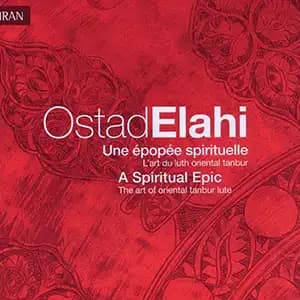
Pā Kotakī Suite
It may seem curious that dance tunes belonging to the secular dimension of life play such a prominent role in a spiritual repertoire. The domains of the secular and the sacred are not as clear-cut in eastern culture as they are in the occidental world, however, and in fact are interwoven. Similarly, the boundary between spiritual and merely human emotions is not always evident, and it is the intention that defines their true nature in every case. After all, it is always possible for an artist to divert a given form from its original purpose and use it according to his needs. In any case, it would be contrary to the principles of spiritual ecology to reduce musical expression to a single purpose such as meditation or dance, or to one type of mood such as nostalgia or tenderness. The playing of Ostad embodies the principle of opposites. As he states: “Antipodal states are necessary for the soul, which is why ancient melodies always come in pairs: An impassioned melody is followed by a sweet melody; a jubilant melody is followed by a nostalgic air, etc.”1 Hence, it is not rare in spiritual gatherings to hear dance tunes identical to those heard at weddings (which generally have a sacred aspect) or celebrations of important figures.
While it is no longer the suffering of being distanced from the Beloved that speaks here, the prevailing feeling is not the elation of union, either. Rather, it is a restrained joy, an intense but regulated vital force. This impression is mainly conveyed by the rhythm, with its seven beats pulsating throughout the whole improvisation with the precision of a quartz metronome. This tension and rigorous progression are not incompatible with a form of sensory exhilaration that can carry a listener to the verge of ecstasy.
This improvisation rests on the theme and rhythmical matrix of a certain Kurdish dance, of which there are about ten different versions. In this particular one, the dancers are gathered in a circle, waving a handkerchief or linking arms. It is named Pāykūbī (literally, tapping one’s foot against the floor) in reference to its special steps. Once the theme is exposed, Ostad adapts several two-beat melodies to his 7/8 rhythm—Tchapī (on E), Saharī (F G Ab Bb Cb Db) and Gol va Khār—before returning to the initial theme. Not content with simply stringing these pieces together one after the other, he actually combines and weaves them together.
Most of these pieces are usually played on the zurnā (oboe) or the dozaleh (double clarinet), accompanied by a powerful dohol (drum). It appears that prior to Ostad these pieces were never played on the tanbur. One of his innovations, therefore, was to adapt these tunes for the tanbur and to create ornamentation typical of wind instruments for the lute. The performance of these tunes on the tanbur requires technique of an unprecedented kind. The most remarkable thing, however, is the set of daring and even modernist technical devices through which Ostad manages to reach a level of musical intensity that is scarcely conceivable on a simple three-stringed lute. At some point, it seems that another voice makes itself heard, perhaps that of the “celestial tanbur,” which he would say occasionally accompanied his own instrument. This piece was recorded at Ostad’s home on April 6th, 1964, on the occasion of a religious feast.
1 Āsār ol-Haqq, vol. 2, p. 360.
Pā Kotakī Suite
A Spiritual Epic